.png)

What Snowy 2.0 means for High-Speed Rail and Brisbane 2032
Updated: May 29

Snowy 2.0: when nation-building ambition outruns governance discipline
Snowy 2.0 should make every government, board and senior executive uncomfortable.
Not because large projects are easy.
Not because complex infrastructure can be estimated with perfect accuracy.
And not because Australia does not need serious investment in energy transition, storage and system resilience.
It should make us uncomfortable because it shows how quickly a compelling national vision can become a locked-in delivery commitment, even when cost, schedule, risk and market conditions change materially.
This is not just a story about a cost overrun.
It is a case study in why complex public programs need independent, unbiased and recurring Gateway Review.

What is Snowy 2.0?
Snowy 2.0 is one of Australia’s largest energy infrastructure projects. It is designed to expand the existing Snowy Hydro scheme by linking the Tantangara and Talbingo reservoirs through approximately 27 kilometres of tunnels and building a new underground pumped-hydro power station.
In simple terms, Snowy 2.0 is intended to operate like a giant battery.
When electricity is plentiful and cheaper, water can be pumped uphill. When electricity is needed, water can be released downhill through turbines to generate power.
The strategic purpose is important. Australia’s energy system needs firming, storage and dispatchable capacity as more renewable generation enters the grid.
The problem is not the strategic intent.
The problem is the gap between the original promise and the current delivery reality.
The 2017 feasibility study estimated Snowy 2.0 at approximately $3.8 billion to $4.5 billion, with first power possible by late 2024. By August 2023, Snowy Hydro had announced a major reset, revising the estimated total project delivery cost to $12 billion, with $4.3 billion already spent.
The delivery timeframe also moved substantially. Snowy Hydro’s updated business case confirmed a revised commercial operation date of December 2028 and a revised total cost to complete of $12 billion.
This is why Snowy 2.0 matters as a governance case study.
It is not simply a project that became more expensive. It is a project where the original assumptions on cost, schedule, technical complexity, geology, commercial risk and market context appear to have changed materially over time.
That should trigger more than a project reset.
It should trigger a full reassessment of the business case, including whether the preferred option remains superior to credible alternatives.

What appears to have gone wrong?
Snowy 2.0 highlights several common failure patterns in complex public programs.
Early estimates became public expectations
Major projects often begin with early estimates that are inherently uncertain.
That is not the problem.
The problem occurs when early estimates become public promises before enough uncertainty has been removed.
Snowy 2.0 moved from an ambitious strategic concept to a nationally significant commitment. Once a project is publicly positioned as a nation-building solution, it becomes much harder for later governance processes to challenge the original assumptions.
The lesson is clear.
Early numbers should be treated as assumptions to be tested, not promises to be defended.
Technical and geotechnical complexity was underpriced
Snowy 2.0 involves extensive tunnelling, underground works, high-pressure water systems, logistics in a sensitive national park environment and major construction interfaces.
These are not routine delivery conditions.
The project has experienced tunnelling difficulties, including issues with the tunnel boring machine Florence. Infrastructure Pipeline records the project’s cost increasing to $12 billion in August 2023, alongside a main contract reset.
The lesson is not that geotechnical risk can be eliminated. It cannot.
The lesson is that complex physical risks must be priced, staged and governed with far greater caution.
The commercial model had to be reset
A major warning sign in any complex project is when the contract model needs to be materially reset.
In August 2023, Snowy Hydro announced it was finalising terms to move to an Incentivised Target Cost contract model with the Future Generation Joint Venture. The stated intent was to create closer collaboration, stronger oversight and better alignment of interests.
That may have been a sensible corrective action at that stage.
However, it also raises a deeper governance question: were the original commercial settings appropriate for the level of uncertainty, complexity and delivery risk?
For complex projects, the contract model is not an administrative detail.
It is one of the core mechanisms through which risk, incentives, behaviour and accountability are shaped.
The business case had to be updated after major cost and schedule changes
Snowy Hydro released an updated business case in May 2024 following the 2023 reset. The update reflected the revised $12 billion cost, the December 2028 commercial operation date, and Snowy Hydro’s position that the project still had a positive net present value.
That is important, but it also reinforces the central governance issue.
When a business case has to be materially updated after cost and schedule movement of this scale, independent reviewers should not only ask whether the revised case can still be justified.
They should also ask whether the revised case is still superior to credible alternatives.
This is where independent gateway review becomes critical.

The project appears to have suffered from commitment escalation
Once billions have been spent, the decision environment changes.
The question can shift from:
Is this still the best investment?
to:
How do we finish what we started?
That is the classic sunk cost risk in major programs.
It does not mean the project should automatically stop. It means continuation should be independently justified using current evidence, current cost, current risk, current market conditions and current alternatives.
The more money already spent, the stronger the independent challenge should become.
Benefits became harder to assess as the project changed
Snowy 2.0 is intended to provide large-scale storage, firming capacity and support for a renewable-heavy grid.
Those are legitimate benefits.
However, benefits should not be assumed simply because the original strategic narrative remains attractive.
As cost increases and delivery moves further into the future, the benefits case must be re-tested.
That reassessment should include whether the same or better system outcomes could be achieved through a portfolio of alternatives, such as other pumped-hydro options, grid-scale batteries, distributed storage, transmission upgrades, demand response or other firming solutions.
The key governance question is not whether Snowy 2.0 has benefits.
The key question is whether those benefits remain worth the current cost, risk and opportunity cost.
Complex projects do not fail all at once
Complex projects rarely fail in a single dramatic moment.
They drift.
A cost increase is explained as manageable.
A schedule delay is treated as recoverable.
A technical risk becomes a delivery challenge.
A delivery challenge becomes a commercial reset.
A commercial reset becomes a revised baseline.
Then, before anyone is prepared to say it out loud, the original business case has changed beyond recognition.
At that point, the governance conversation often shifts from:
Should we continue?
to:
How do we justify continuing?
That is where optimism bias, sunk cost fallacy and political commitment become dangerous.
The Gateway Reviews must be more than a compliance checkpoint
For major public programs, independent Gateway Reviews should not be treated as a procedural requirement or a late-stage assurance exercise.
It should be designed as a decision protection mechanism.
Its purpose is to help Sponsors and decision-makers confront uncomfortable evidence while they still have genuine choices.
An effective gateway review should test whether the program remains:
Strategically necessary.
Affordable.
Deliverable.
Commercially sound.
Aligned to benefits.
Superior to credible alternatives.
Within the risk appetite of government.
Still the best use of public money.
That last point is critical.
A project can be “progressing” and still no longer represent the best value decision.
The business case must stay alive
A business case is not a document to secure approval.
It is a living governance instrument.
For a multi-billion-dollar program, the business case should be independently reassessed at every major commitment point, particularly when cost, schedule, risk profile, market conditions or technology options change.
This does not mean assuming that one alternative would have been better.
It means the selected option should be repeatedly tested against a changing market.
For Snowy 2.0, that reassessment should have included a fresh look at the full portfolio of available options, including pumped hydro alternatives, grid-scale batteries, demand response, transmission upgrades, distributed storage, firming technologies and other emerging energy solutions.
The point is not to argue with hindsight that a specific alternative would definitely have been faster or cheaper.
The point is that the governance system should have required the question to be asked independently, repeatedly and transparently.

What Snowy 2.0 means for High Speed Rail and Brisbane 2032
The Snowy 2.0 lesson is not confined to energy infrastructure.
It has direct relevance for two of Australia’s most significant future public investment programs: High Speed Rail and the Brisbane 2032 Olympic and Paralympic Games.
Both have compelling strategic narratives.
High Speed Rail promises productivity, regional development, housing access, transport transformation and long-term national connectivity. Infrastructure Australia lists the Newcastle to Sydney High Speed Rail proposal as an investment-ready planning investment, with the business case evaluated in July 2025.
Brisbane 2032 promises a once-in-a-generation opportunity to deliver sporting, transport, housing, tourism and community legacy outcomes. The Queensland Government’s 2032 Delivery Plan refers to a $7.1 billion venue infrastructure funding envelope, covering new venues and upgrades to existing venues.
The strategic ambition in both cases is significant.
But Snowy 2.0 shows that strategic ambition is not enough.
Large models that are strong enough to withstand optimism bias, political pressure, delivery enthusiasm, early estimate uncertainty and sunk cost escalation.

The High Speed Rail lesson
High Speed Rail has been discussed in Australia for decades.
The risk is that long-standing aspiration can create a sense of inevitability before the delivery pathway is sufficiently tested.
The lesson from Snowy 2.0 is not to abandon ambition.
The lesson is to avoid premature certainty.
For High Speed Rail, independent gateway review should test:
Governance issue | Gateway challenge question |
Corridor selection | Is the first corridor still the highest-value starting point compared with other options? |
Staging | Can the program be delivered in viable stages that create benefits early? |
Demand | Are patronage, pricing, housing and regional development assumptions independently tested? |
Integration | Is the program integrated with airports, metro, heavy rail, housing and land-use planning? |
Cost realism | Are tunnelling, land acquisition, stations, utilities, signalling and systems costs realistic? |
Benefits | Are productivity, housing, decarbonisation and regional growth benefits measurable and attributable? |
Alternatives | Would other transport, housing or regional development investments deliver better value sooner? |
Delivery model | Is the governance model capable of managing a multi-decade, multi-government program? |
The key issue is not whether High Speed Rail is a good idea in principle.
The key issue is whether each stage remains the best use of public capital when tested against current evidence and credible alternatives.
Snowy 2.0 shows the danger of allowing a preferred option to become politically and emotionally locked in before uncertainty has been sufficiently reduced.
The Brisbane 2032 lesson
Brisbane 2032 has a different complexity profile.
Unlike Snowy 2.0 or High Speed Rail, the Games has a fixed deadline. The opening ceremony will not move because infrastructure is late.
That creates a very different governance challenge.
Time pressure can compress decision-making, reduce options, increase delivery premiums and make governments more vulnerable to scope creep. It can also create a “must deliver at any cost” environment.
The 100 Day Review into Brisbane 2032 infrastructure was an important recognition that the delivery model needed stronger scrutiny and coordination.
For Brisbane 2032, independent gateway review should focus not only on whether venues and villages are on track, but whether the program is still protecting legacy value.
Gateway review should test:
Governance issue | Gateway challenge question |
Scope control | Are Games requirements being separated from broader legacy aspirations? |
Legacy | Will each major investment deliver value beyond the closing ceremony? |
Deadline risk | What decisions are being made purely because time is running out? |
Cost escalation | Are acceleration premiums, labour constraints and supply chain risks visible? |
Benefits | Are community, tourism, housing, transport and sporting benefits being actively managed? |
Governance | Are responsibilities clear across state, federal, local government and delivery authorities? |
Public confidence | Is reporting transparent enough to maintain trust? |
Option discipline | Are temporary, modular or lower-cost options being properly compared with permanent builds? |
The Olympics can be a catalyst for long-term public value, but only if the governance model resists the temptation to justify every investment through the Games narrative.
A venue, village or transport upgrade should not be approved simply because it can be linked to 2032.
It should be approved because it represents the best long-term public value.

The shared lesson
Snowy 2.0, High Speed Rail and Brisbane 2032 are very different programs.
But they share the same core governance risks:
Political commitment can outpace evidence.
Early estimates can become public promises.
Preferred options can become protected options.
Delivery urgency can weaken challenge.
Benefits can become assumed rather than managed.
Sunk costs can make reassessment harder.
Complexity can be underpriced.
Independent advice can arrive too late.
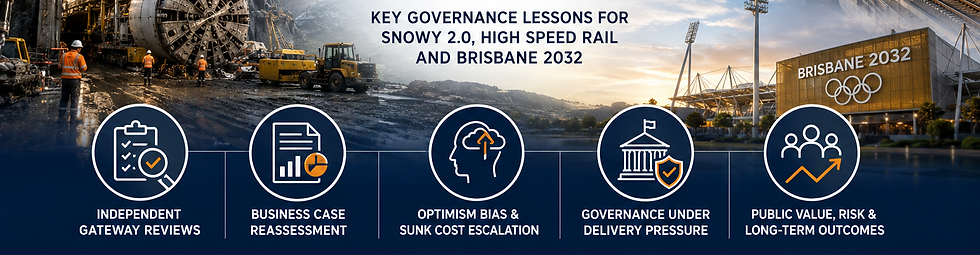
This is why independent Gateway Reviews should be embedded early with integrated assurance, repeated regularly and tied directly to funding decisions.
For projects of this scale, the question should never be:
How do we keep going?
The question should be:
Is this still the right thing to do, in the right way, at the right cost, for the right benefits?
Conclusion
Snowy 2.0 should prompt a broader conversation about how Australia governs complex public investments.
The lesson is not that governments should avoid ambition.
Australia needs ambition.
We need energy transition, faster connectivity, better cities, stronger regions and successful global events.
But ambition without disciplined governance becomes exposure.
High Speed Rail and Brisbane 2032 should not be managed as projects that simply need to be delivered. They should be governed as complex public value programs that must continually re-justify their scope, benefits, options and delivery approach.
The bigger the promise, the stronger the independent challenge must be.
Because the true failure of complex governance is not discovering that a project has become difficult.
It is continuing to defend yesterday’s decision after the evidence has changed.
👉 Let’s turn purpose into measurable outcomes.
Contact PMLogic to strengthen strategy, governance, and delivery capability.


Comments