.png)

2025 PMAA Community Winners Showcase Blog
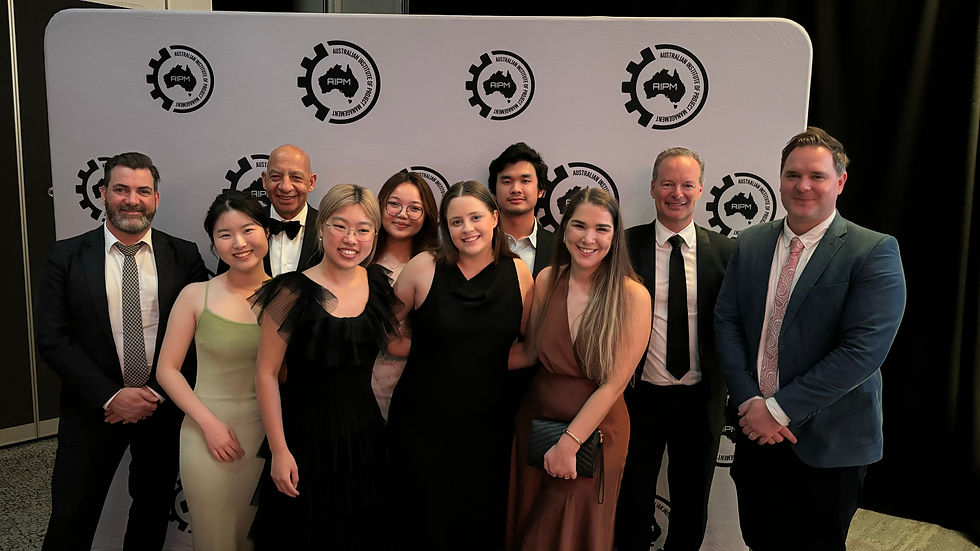
The Smith Family and PMLogic presented at AIPM’s PMAA™ 2025 Winner Showcase last Wednesday on The Smith Family’s Environmental Sustainability Strategy. Sharing the experience and knowledge that got us recognised for delivering lasting social impact through deep community engagement and purposeful leadership.

Driving Change Through Education and Sustainability
The Smith Family has always championed education as a powerful agent of change, striving for a world where every child has the opportunity to change their future. Their purpose—to overcome educational inequality caused by poverty—now intersects with another pressing challenge: climate change. Research consistently shows that those from lower socio-economic backgrounds are disproportionately impacted by climate change due to limited resources, higher exposure to environmental hazards, and reduced capacity to adapt. This makes sustainability not just an environmental issue, but a social equity imperative.

Why an Environmental Sustainability Strategy?
The Smith Family recognises that environmental sustainability is deeply connected to their mission. Climate change exacerbates poverty and educational inequality, creating barriers for vulnerable children. By embedding sustainability into their operations, they aim to reduce their own environmental footprint while modelling responsible practices for the NFP sector. Although their direct levers are limited, they have identified three key areas where they can make a measurable difference:

Property – reducing emissions from office spaces.
Travel – minimising carbon impact from organisational mobility.
Consumables – promoting responsible use and waste reduction.
Their people are central to this approach, acting as champions for sustainability and driving cultural change across the organisation.

Case Studies: Turning Strategy into Action
1. Digitisation Project
Initiated in 2019, this project aimed to digitise correspondence for sponsored students, reducing paper use and emissions. Initially focused on cost savings and efficiency, it evolved into a sustainability success story:
2019: 57,130 items sent, averaging 78g CO₂ per item.
2023: 106,467 items sent, averaging 29g CO₂ per item.
Annual saving: 5.2 tonnes CO₂.
Total saving since inception: 14.1 tonnes CO₂.
2. Digital Learning Essentials
This initiative bridges the digital divide while reducing e-waste. By refurbishing and redistributing laptops, The Smith Family allows students to engage in their education at home and at school. The other three components of this project include providing:
Reliable internet access for online research and education.
Access to a technical support helpline and digital skills information hub.
Support to expand digital skills including how to stay safe online.
Impact (2023–present):
3,240 laptops donated, with 2,483 passed on to students.
440 laptops recycled, saving 3,137.5kg of e-waste.

Our Approach
The Environmental Sustainability Strategy Project faced challenges with no dedicated project lead, competing priorities, and schedule delays. PMLogic stepped in to provide structure and clarity through a comprehensive program plan and our environmental sustainability experience, ensuring the initiative stayed on track. PMLogic helped to fill in resourcing gaps which had been critically affecting the delivery, by leveraging our extensive professional and academic networks. A tailored standards underpinned ESG framework benchmarking tool was developed by PMLogic, enabling The Smith Family to gain a data driven baseline understanding of its environmental footprint.
Want to read more about our approach? Check out the case study here
The Environmental Sustainability Strategy Project with The Smith Family has set a precedent in the not-for-profit (NFP) sector. Historically, there was no clear blueprint for integrating sustainability into NFP operations. This initiative demonstrates that with the right program management approach, even organisations with limited levers can achieve measurable environmental impact while staying true to their core mission.
![[2] Myth Busting – Is Sustainability too Expensive?](https://static.wixstatic.com/media/cb2142_8096ff40a936403c91234deac2152a0d~mv2.png/v1/fill/w_980,h_551,al_c,q_90,usm_0.66_1.00_0.01,enc_avif,quality_auto/cb2142_8096ff40a936403c91234deac2152a0d~mv2.png)
![[1] Harnessing Environmental Sustainability in Non-Profit Projects: Beyond Social Impact](https://static.wixstatic.com/media/cb2142_ec472c998a0d4975a8356478534e6bc8~mv2.png/v1/fill/w_980,h_551,al_c,q_90,usm_0.66_1.00_0.01,enc_avif,quality_auto/cb2142_ec472c998a0d4975a8356478534e6bc8~mv2.png)

Comments