.png)

PMLogic's B Corp Journey
Updated: Jul 21
In 2022, PMLogic became a Certified B Corporation™.
At the time, the certification validated something we had been working towards for years — a way of delivering projects that considers not only performance outcomes, but the broader environmental and social impact those projects create.
It is how becoming a B Corp has changed the way we operate, deliver, and define success.
Before 2022: The tension
Before certification, PMLogic was already working across complex programs, particularly in public sector environments, where decisions have long-term consequences for communities and environments.

In these programs, delivery success is traditionally measured through time, cost, and scope. However, on the ground, it was clear that these metrics only told part of the story.
Projects that met delivery targets did not always leave a positive legacy. Sustainability considerations varied significantly across agencies and stakeholder groups. Programs succeeded contractually, but environmental outcomes depended heavily on local interpretation and capability.
This created a persistent tension in our work:
How do you balance efficiency with environmental responsibility?
How do you deliver consistently across multiple stakeholders with varying levels of maturity?
How do you influence outcomes when sustainability is not always embedded into governance frameworks?
These challenges highlighted a gap — not just within individual projects, but in how programs were structured and measured overall.
2022: Certification
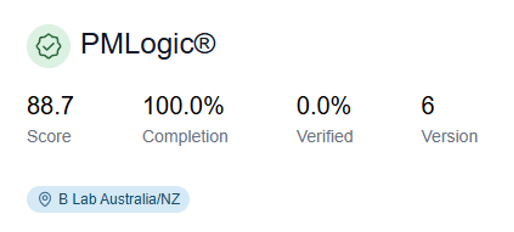
Becoming a B Corp in 2022 required PMLogic to formalise how it assessed impact across governance, environment, and community.
For the first time, we were required to:
Quantify environmental and social impact in a structured way
Align internal practices with externally defined standards
Commit to reassessment and improvement over time
It also introduced something critical: external accountability and continuous reassessment. Our goal is not just to offset impact, but to continually reduce it at source, aligning with the principle of continuous improvement that underpins the B Corp movement.

2023 – Present: Embedding B Corp
Following certification, the challenge became practical:
How do you embed B Corp principles into a consulting business where the majority of impact is delivered through clients and programs, rather than through direct operational footprint?
In the workplace
One of the early decisions was relocation to an office which met an over 5-star NABERS rating. Currently, we work in TWP co-working space at Quay Quarter Tower with a 6 Star Green Star rating and a commitment to long-term ecological impact.
It reflected a shift towards working in an environment where sustainability is actively considered in how space is designed, used, and maintained. Workplace environments shape behaviour. They influence how people consume resources, how they collaborate, and how seriously sustainability is taken in day-to-day decisions.
Alongside this, we began to make more deliberate operational choices — not as isolated initiatives, but as part of a consistent direction:
Reducing the need for travel through flexible and digital delivery models
Structuring teams so that members are geographically aligned to clients, minimising unnecessary movement
Over time, these actions have shifted sustainability from an abstract value to something that is visible and normalised within the business.

Program delivery
While operational improvements are important, they represent only a small proportion of PMLogic’s overall impact. The most significant influence comes through the programs we help design and deliver.
This became particularly evident through the Regional and Local Roads Repair Program (RLRRP). The scale and structure of this program provided an opportunity to move beyond isolated sustainability efforts and instead influence system-wide outcomes across multiple councils. What changed in this program was not just the inclusion of sustainability initiatives, but how they were positioned within delivery.

This shift is reflected in the outcomes:
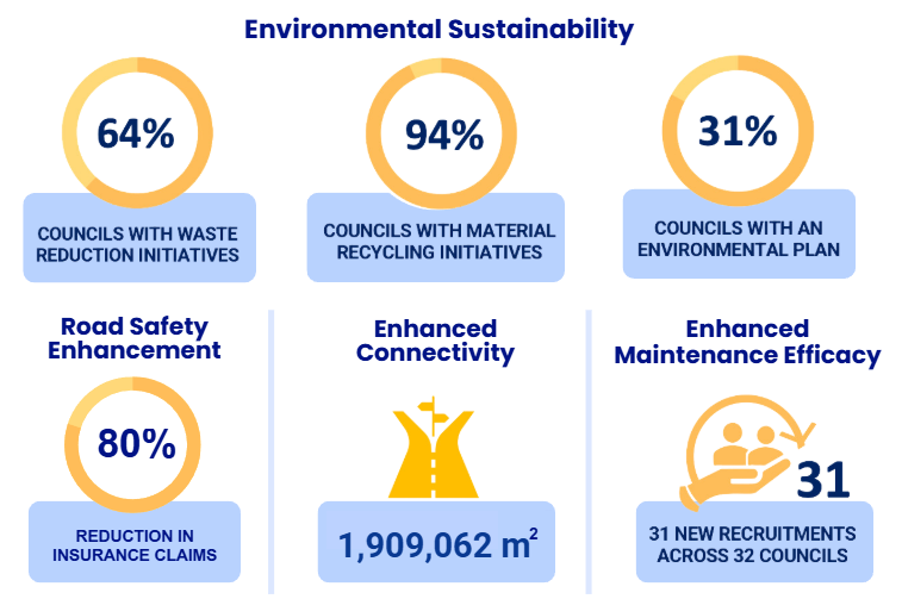
A majority of participating councils (64%) — implemented waste reduction initiatives, indicating that sustainability was no longer limited to a small number of leading organisations
94% of councils adopted material recycling practices, demonstrating that circular approaches to infrastructure delivery can be scaled when embedded into program structures
31% of councils developed formal environmental plans, representing a deeper level of maturity where sustainability is planned, rather than reactive
What is particularly significant is that these outcomes were achieved within a program primarily designed for infrastructure delivery, not environmental transformation.
This demonstrates that when sustainability is integrated into program frameworks, it can become an expected part of delivery, rather than a competing priority. At the same time, the program continued to deliver broader benefits:
Improved road safety, contributing to an 80% reduction in insurance claims
Over 1.9 million square metres of road upgrades, strengthening regional connectivity
The creation of 31 new roles across 32 councils, supporting local capability and delivery capacity
These results reinforce an important point that environmental and social outcomes do not need to come at the expense of delivery performance — they can be leveraged to enhance outcomes when embedded correctly.
Serving community
B Corp has also influenced how PMLogic thinks about impact outside of commercial delivery. This is particularly visible in the way we engage with not-for-profit organisations and structure our events.
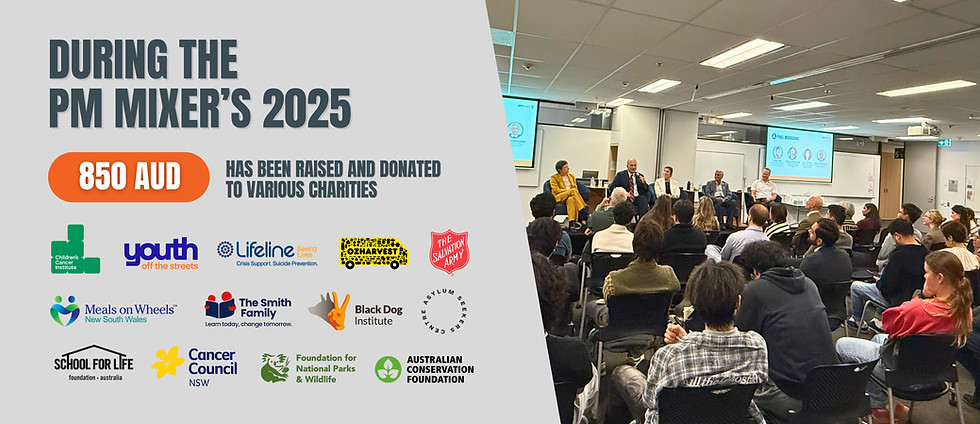
Through our work with The Smith Family, PMLogic has applied its core capability — program and project management — in a pro bono context, supporting initiatives that have long-term social value. This approach reflects a deliberate choice to contribute expertise, not just funding. It ensures that impact is sustained and scalable, rather than one-off.
Similarly, events such as the PM Mixer have evolved not only operate in a way that is consistent with sustainability principles (waste-free, resource-conscious), but also generate direct community benefit, with all proceeds directed towards charitable causes.
Our footprint
Alongside program delivery and community initiatives, PMLogic has also taken steps to better understand its direct environmental impact.
Through Ecologi, we have introduced structured measurement and offsetting of emissions, alongside support for verified climate projects such as reforestation.


The next phase
As PMLogic approaches its next recertification, the focus is less on adding new initiatives and more on deepening integration. This means continuing to strengthen how sustainability is embedded into:
Program governance and reporting frameworks
Decision-making processes across delivery
Measurement of environmental and social outcomes at scale
It also means increasing transparency — not only in what is achieved, but in where improvement is still required.
Because that is ultimately what B Corp represents:
Not a benchmark that is reached, but a standard that continues to move.
Looking to embed sustainability into your projects, programs or portfolio?
At PMLogic, we help organisations deliver lasting value by integrating sustainable practices into governance, delivery and decision-making.
Get in touch to learn how we can support your journey.


Comments